The Triangle: Why Schools, Tutors and Families Work Better Together
The Triangle: Why Schools, Tutors and Families Work Better Together
A few weeks ago, a Head of English emailed me about a student I'd been working with for almost a year. She wanted to know how the girl had been finding her preparation, where her confidence sat, what she was like to teach. A short email. A useful one. By the end of that week, the family in Shanghai had accepted the offer.
That conversation wouldn't have happened five years ago. The school would have made its judgement from the entrance assessment and the interview. The family would have made their decision from the prospectus and the agent's recommendation. I would have stayed in my lane, preparing the next student for the next exam. Everyone would have done their job. The placement might still have happened. But it wouldn't have happened with that particular quality of confidence, on either side.
What that email represented is becoming more common. And it's worth paying attention to.
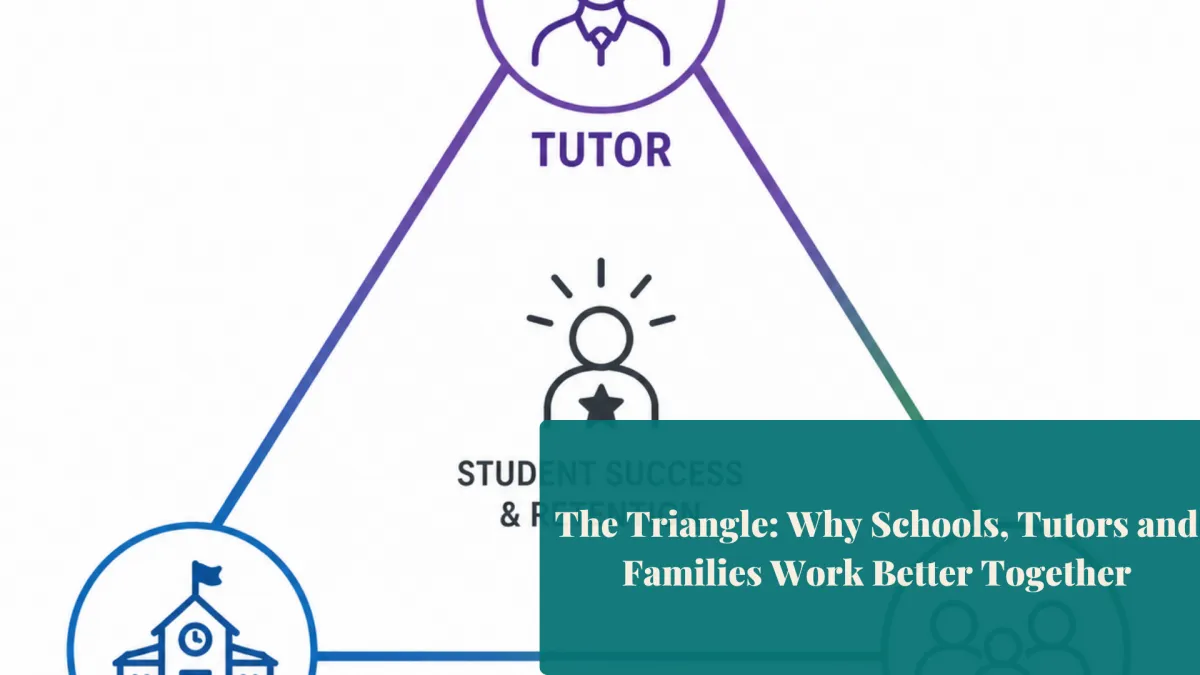
The triangle
Three points. The school, the family and the tutor who knows the child.
When those three points are connected, something shifts. Recruitment becomes warmer. Retention becomes stronger. The experience of being an international family at a British boarding school starts to feel coherent, rather than like a series of managed handovers across different time zones and institutions.
Here's what I keep seeing happen when it works.
What tutors actually bring to the table
Tutors who work with international families occupy a position that nobody else in the system can occupy. They know the child academically, in a depth that an admissions interview can't reach in forty-five minutes. They know the British school landscape from the inside, often having taught in it themselves. And they know the family, sometimes for years before a school is even chosen, across cultures, time zones, and the small daily moments that tell you more about a child than any assessment report.
Tutors are often the bridge between the British educational world and the family's first language and frame of reference. They translate not just the content of a school's expectations, but the meaning behind them. They're the person a parent in Beijing or Dubai messages at ten o'clock at night when something feels uncertain, and the person who can put it gently into context.
When a tutor like that is working alongside a school, the school benefits in ways that take months and years to show up. The child arrives more prepared, academically and emotionally. The parents arrive more confident, which makes them better partners in their child's education. The tutor becomes a quiet ambassador for the school in markets the school could never reach on its own.
What happens when schools are receptive
I've watched the same things happen, again and again, when a boarding school welcomes the tutor into the conversation rather than treating them as a separate world.
The first shift is in the family's confidence. The moment a parent sees that their child's tutor and their child's school are talking to each other, something settles. Sending a child thousands of miles away is an enormous decision. Anything that signals "we are all on the same team" lowers the temperature of that decision.
The second shift is in fit. When tutors share what they genuinely know about a child (work ethic, areas of strength, the small worries the parents haven't quite named) schools place that child more accurately. The right house. The right academic stream. Fit is the unsung hero of retention. Children who fit, thrive. Children who thrive, stay.
The third shift is in the relationship with the agent. Agents notice everything. When they see that a school treats tutors as professionals and partners rather than peripheral figures, they trust that school with their most important families. That trust compounds, year on year, until a school becomes one of the names mentioned first.
The fourth shift is harder to put on a spreadsheet, but it may be the most important. The child is simply more visible. There are more eyes on them. A small dip in confidence, a quiet struggle with a particular subject, a moment of homesickness that hasn't surfaced at school, the tutor often sees these things first. When the channels are open, that information flows quickly to the right person, and small wobbles get steadied before they become anything bigger.
Why this matters more than it might appear
International families are choosing differently than they were five years ago. They are more informed, more discerning, and more relational. They are not just looking for the school with the best results or the most beautiful grounds. They are looking for an environment that feels coherent, where the people around their child are connected to each other, where information moves freely, and where the family doesn't feel like they're managing handovers from the other side of the world.
A school that welcomes tutors into the conversation offers something that is genuinely hard to replicate: a softer landing. And softer landings convert. Not just at the point of enquiry, they convert at the open day, at the offer stage, at the deposit stage, and at the moment a family sits down to write their first review on a Chinese parenting forum.
Retention tells the same story, but more slowly. A child who stays from Year 9 through to Year 13 becomes part of the school's story. Their family mentions the school in WeChat groups. Their younger siblings follow them through. A child who leaves after a year takes all of that potential with them.
The triangle makes staying easier. Not through anything dramatic, but through the accumulation of small things being caught. The tutor flags that homework has felt heavy this term. The houseparent mentions that the child has seemed quieter. The parent shares that the grandparents are visiting and the family is feeling more emotional than usual. None of these moments alone is significant. Together, they form a picture. And the tutor is often the one who holds the most complete version of that picture, because they sit just outside the school structure but right inside the family's daily life.
Schools that embrace this aren't outsourcing pastoral care. They are extending it. They are quietly increasing the number of caring adults in a child's life, and making sure those adults can actually talk to each other.
What this looks like in practice
The schools already doing this aren't doing anything elaborate. They're inviting tutors to open mornings. They're welcoming a quick email from a tutor about a child before an interview. They're sharing assessment outcomes with the wider team around the child, not just the parent. They're treating the tutor's relationship with the family as something worth working with, not around.
And the tutors stepping into this work are doing it with care. They're not trying to replace anyone. They're showing up as the education professionals they are: clear about their role, generous with their knowledge of the system, respectful of the school's authority, and quietly committed to the child at the centre of it all.
This sector has historically operated in parallel lanes. Schools in one. Tutors in another. Agents and families navigating between them. What I'm seeing now, in the schools doing the best international work and the tutors building the most trusted practices, is those lanes beginning to converge. Not in a way that loses any of the rigour. In a way that adds to it.
The British boarding sector has something genuinely valuable to offer. That doesn't change. What changes is how families experience it from the other side of a long flight and a longer decision.
If you're a school leader who's curious about how this looks in practice, the conversations are easier to start than you might think. Many of the tutors already in the lives of your prospective and current families would welcome the chance to work alongside you properly.
And if you're a tutor wondering whether you really do have something to offer in that conversation, you do. The triangle works because of you.